A New Apex in Barcelona's Skyline: Sagrada Familia Reaches 176 Meters to Become World's Tallest Church
For over 140 years, Antoni Gaudí’s Sagrada Familia has been an enduring symbol of architectural ambition, spiritual devotion, and an unyielding commitment to a vision spanning generations. Now, this iconic basilica in Barcelona has achieved an monumental milestone, officially becoming the tallest church in the world. With the completion and crowning of its central Tower of Jesus Christ, the Sagrada Familia now majestically pierces the heavens at a breathtaking 176 meters, rewriting history and solidifying its place as an unparalleled engineering and artistic marvel. This incredible vertical ascent has not only captivated the world but also brought to the forefront the sheer scale and profound significance of the
Hauteur Sagrada Familia.
The journey to this record-breaking height has been a century-long saga, marked by periods of intense construction, devastating setbacks, and miraculous resilience. But it is the recent installation of the monumental cross atop the Jesus Christ Tower that truly marks this pivotal moment, ushering in a new era for Gaudí's unfinished masterpiece and for architectural achievements worldwide.
The Final Ascent: Deconstructing the 176-Meter Achievement
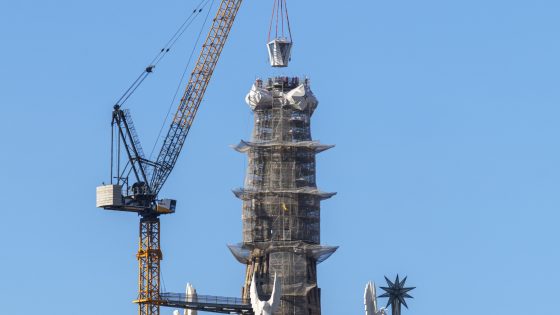
The pinnacle of the Sagrada Familia's towering structure is the Tower of Jesus Christ, which itself rises to an impressive 172.5 meters. However, it is the magnificent cross, now permanently affixed to its summit, that pushes the total height to the unprecedented 176 meters. This wasn't merely the placement of a capstone; it was a complex engineering feat and a profound symbolic gesture.
The cross itself is a work of art and engineering, measuring 17 meters tall and 13.5 meters wide. Crafted with exquisite detail, it is revested in glass and gleaming white enameled ceramic, designed to catch the sunlight and radiate its presence across the Barcelona skyline. Constructed in Germany in 2025, the cross was meticulously assembled on site in seven distinct pieces: the lower arm, the central core, four lateral arms, and finally, the crowning upper arm.
Inside this monumental cross, a sculpture of the Agnus-Dei (the Lamb of God) by artist Andrea Mastrovito is placed, a poignant reference to Gaudí's original theological and architectural vision. This final external addition to the highest point of the basilica was completed in February 2026, a truly momentous occasion that saw the silhouette of the Sagrada Familia expand further into the sky. For a deeper dive into the symbolic and structural completion of this iconic feature, read our related article:
Gaudí's Dream Towers: Sagrada Familia's Jesus Cross Completed.
The completion of the Tower of Jesus Christ, marking the highest point, signifies the culmination of many years of dedicated work and painstaking study of Antoni Gaudí's intricate legacy. As architect in chief Jordi Faulí expressed, "The completion of the cross on the Tower of Jesus Christ represents far more than the conclusion of a construction phase: it is the fruit of many years of work and study of the heritage that Antoni Gaudí left us."
Surpassing Giants: How Sagrada Familia Claimed the Tallest Church Title
The Sagrada Familia's ascent to 176 meters firmly establishes it as the world's tallest church, officially surpassing previous record holders. For decades, the Ulm Minster in Germany held the prestigious title, having proudly stood at 161.53 meters since 1890. While the Sagrada Familia had already edged past Ulm Minster's height even before the full cross was installed (reaching 162.91 meters with the early stages of the cross), the final 176-meter measurement makes its claim to the title indisputable.
This achievement is more than just a numbers game; it's a testament to human perseverance, technological advancement, and an unwavering commitment to an artistic vision. The Sagrada Familia's journey has been unique, driven not by the ambition of a single generation to break records, but by the slow, organic unfolding of a master plan left behind by its visionary architect. The basilica's verticality is not just about height but about its spiritual message, drawing the eye and soul heavenward. The awe-inspiring
Hauteur Sagrada Familia now stands as a beacon for Barcelona and the world. Discover more about this remarkable achievement in our article:
Barcelona Icon Soars: Sagrada Familia Reaches Record 176m Height.
Gaudí's Enduring Vision: A Century in the Making
The story of the Sagrada Familia began in 1882, but it truly took flight a year later when the young and brilliant Antoni Gaudí took over the project. He inherited a conventional neo-Gothic design but transformed it into something profoundly revolutionary. Gaudí's architectural genius blended elements of Gothic revival with entirely new, organic forms inspired by nature, creating a unique style often described as "Gaudí Modernism." His designs incorporated intricate symbolism, natural light, and structural innovations that were far ahead of their time.
Tragically, Gaudí's life was cut short in 1926, leaving his magnum opus far from complete. At the time of his death, only one of the planned eighteen towers had been built, along with parts of the Nativity Facade. The progress since has been an extraordinary testament to collective will and the power of sustained effort. The construction, famously funded by donations from repentant worshippers in its early days, now largely relies on ticket sales from the approximately 13,000 visitors who flock to the basilica daily. This steady stream of revenue has been crucial in maintaining the momentum of such an ambitious undertaking.
The completion of the Jesus Christ Tower and its cross in 2026 holds particular significance, coinciding with the centennial of Antoni Gaudí's death. This symbolic timing underscores the enduring legacy of the architect and the commitment of those who have worked tirelessly to realize his dream. A series of commemorative events, including a mass dedicated to Saint Joseph celebrating the original cornerstone laying in 1882, mark this milestone year.
Gaudí’s plans, though detailed, were often conceptual, relying on models and drawings rather than complete blueprints. Modern architects and engineers have used advanced technology, including 3D modeling and computer-aided design, to interpret and execute his complex vision, translating his organic and intricate forms into tangible stone and steel. The challenge has been immense, but the results are a powerful bridge between 19th-century genius and 21st-century capability.
Planning Your Visit: Experiencing the World's Tallest Church
With the Sagrada Familia now holding the title of the world's tallest church, there has never been a more exciting time to witness this architectural wonder. Its towering presence, now officially crowned at 176 meters, offers a fresh perspective on a structure that has continually evolved before our very eyes.
Here are some tips for experiencing the unparalleled
Hauteur Sagrada Familia and the basilica as a whole:
*
Book Tickets in Advance: The Sagrada Familia is one of Spain's most visited monuments. To avoid long queues and ensure entry, especially during peak seasons, purchase your tickets online well ahead of your visit.
*
Choose a Guided Tour: While self-exploration is rewarding, a guided tour can provide invaluable insights into Gaudí's symbolism, the construction history, and the architectural nuances that might otherwise be missed.
*
Ascend the Towers: For breathtaking panoramic views of Barcelona and an up-close perspective of the basilica's intricate details, consider purchasing a ticket that includes tower access. The Passion and Nativity facades offer different perspectives. Note that the Jesus Christ Tower is not yet open to visitors.
*
Look Up, Way Up: Spend time appreciating the interior's forest-like columns, the kaleidoscopic stained-glass windows, and the sheer verticality that draws your gaze upwards towards the newly completed highest point.
*
Visit at Different Times: The play of light through the stained glass changes dramatically throughout the day. Early morning or late afternoon often provide the most stunning visual effects.
*
Explore the Museum: Located in the basement, the museum offers fascinating insights into Gaudí's life, his design process, and the ongoing construction challenges, featuring original models and explanations.
While the exterior of the Jesus Christ Tower is complete, interior work on the tower and other sections of the basilica will continue in 2027 and 2028, with the full completion of the entire Sagrada Familia anticipated for 2032. Each stage of construction offers a unique opportunity to witness history in the making.
Conclusion
The Sagrada Familia's elevation to the world's tallest church at 176 meters is more than just an architectural statistic; it is a profound testament to a dream that has spanned centuries. From Antoni Gaudí's initial vision to the tireless efforts of countless architects, artisans, and construction workers, this basilica embodies perseverance, spiritual aspiration, and an unwavering belief in the power of art. The completed Tower of Jesus Christ, crowned by its magnificent cross, not only reshapes Barcelona's iconic skyline but also stands as a triumphant symbol of human ingenuity and devotion. The monumental
Hauteur Sagrada Familia now invites millions worldwide to look up, marvel, and witness a living masterpiece continually reaching for the heavens.